In today’s rapidly evolving industrial and commercial landscape, efficient cable management has become more important than ever. From manufacturing plants and power stations to hospitals, data centers, and commercial buildings, electrical systems rely on organized cable routing to ensure uninterrupted operations, enhanced safety, and easy maintenance.
One of the most trusted solutions for managing electrical cables is the cable tray system. Among the various types available, Ladder Cable Trays and Perforated Cable Trays are the two most widely used options due to their durability, versatility, and ease of installation. Although both serve the primary purpose of supporting and organizing cables, each is designed to meet specific installation requirements and operational demands.
Understanding Cable Tray Systems
A cable tray is a structural support system designed to hold and route insulated electrical cables used for power distribution, communication, instrumentation, and data transmission. Unlike traditional conduit systems, cable trays provide an open pathway that simplifies cable installation while allowing easy access for inspection, maintenance, and future expansion.
Cable tray systems are widely preferred because they reduce installation time, lower labor costs, and improve cable organization. They also make it easier to identify faults, replace damaged cables, or add new wiring without disrupting the existing system.
Today, cable trays are commonly installed in:
- Industrial manufacturing units
- Commercial office buildings
- Hospitals and healthcare facilities
- Airports and railway stations
- Shopping malls
- Educational institutions
- Power generation plants
- Oil & gas industries
- Data centers
- Infrastructure projects
Depending on cable type, load, and environmental conditions, different cable tray designs are selected to ensure optimal performance.
What is a Ladder Cable Tray?
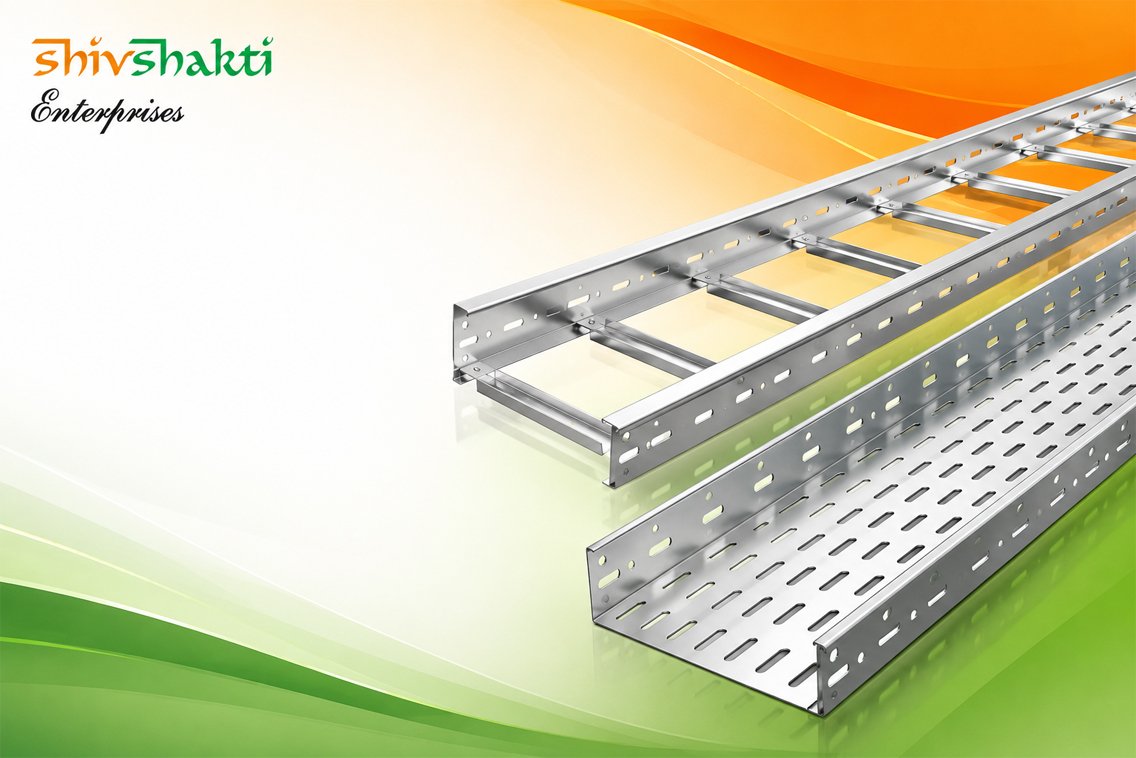
A Ladder Cable Tray is one of the most robust cable support systems available. It consists of two parallel side rails connected by evenly spaced cross members, giving it the appearance of a ladder. This open construction provides excellent strength while allowing maximum airflow around the cables.
Ladder cable trays are primarily used for heavy-duty power cables where heat dissipation and high load-bearing capacity are essential. Their design also makes pulling cables during installation much easier, particularly for long cable runs.
Key Features of Ladder Cable Trays
- Open ladder-style construction
- Excellent ventilation
- High mechanical strength
- Suitable for long cable spans
- Supports heavy cable loads
- Easy cable installation and replacement
The simplicity of the ladder design makes it one of the most reliable cable management solutions for demanding industrial environments.
Benefits of Ladder Cable Trays
Superior Heat Dissipation
Electrical power cables generate heat during operation. Excessive heat can reduce cable efficiency and shorten insulation life. The open design of ladder trays promotes natural air circulation, helping dissipate heat effectively and improving overall cable performance.
High Load-Bearing Capacity
Ladder cable trays are engineered to carry large bundles of heavy electrical cables over long distances. Their strong construction minimizes sagging and maintains structural stability even under demanding conditions.
Faster Cable Installation
The open structure allows installers to pull cables through the tray with minimal resistance. This significantly reduces installation time, especially in large industrial projects.
Easy Inspection and Maintenance
Since cables remain visible and accessible, routine inspections, troubleshooting, repairs, and future modifications can be performed quickly without dismantling the entire cable routing system.
Reduced Long-Term Costs
The durability of ladder cable trays, combined with lower maintenance requirements, makes them a cost-effective investment for long-term infrastructure projects.
Common Applications of Ladder Cable Trays
Because of their strength and ventilation capabilities, ladder cable trays are commonly installed in:
- Power plants
- Oil & gas facilities
- Chemical processing plants
- Steel manufacturing units
- Cement factories
- Mining operations
- Utility substations
- Renewable energy projects
- Heavy engineering industries
- Large industrial warehouses
These industries often require extensive power distribution systems that demand reliable cable support and efficient heat management.
What is a Perforated Cable Tray?
A Perforated Cable Tray features a flat metal base with evenly distributed holes or slots throughout its surface. These perforations provide adequate ventilation while offering continuous support across the entire cable length.
Unlike ladder trays, perforated trays prevent smaller cables from sagging between support points, making them ideal for communication, instrumentation, networking, and light-to-medium power cables.
Their clean appearance also makes them a popular choice for commercial buildings where aesthetics are an important consideration.
Key Features of Perforated Cable Trays
- Continuous cable support
- Uniform perforations for ventilation
- Smooth cable routing
- Better protection for smaller cables
- Suitable for wall, ceiling, and floor installations
- Available in multiple widths and thicknesses
Perforated trays strike an excellent balance between cable protection, airflow, and organization.
Benefits of Perforated Cable Trays
Better Cable Protection
The continuous bottom surface evenly distributes cable weight, reducing stress on the insulation and minimizing the chances of cable deformation over time.
Improved Cable Organization
Perforated trays allow installers to neatly arrange multiple cable types while maintaining clear separation between power, communication, and control wiring.
Enhanced Safety
The tray design minimizes the risk of smaller cables slipping through openings, ensuring better cable stability throughout the installation.
Easy Installation
Perforated trays are lightweight, versatile, and compatible with numerous mounting accessories, making installation straightforward for contractors.
Professional Appearance
Their enclosed design creates a cleaner and more organized look, making them particularly suitable for commercial buildings where exposed cable management should appear neat and structured.
Common Applications of Perforated Cable Trays
Perforated cable trays are extensively used in:
- Commercial office buildings
- Hospitals
- Hotels
- Educational institutions
- Shopping malls
- IT parks
- Data centers
- Pharmaceutical industries
- Food processing facilities
- Residential high-rise buildings
They are particularly effective where cable organization, moderate ventilation, and enhanced protection are priorities.
Materials Used in Cable Tray Manufacturing
The performance and durability of cable trays largely depend on the material used during manufacturing. Different environments require different levels of corrosion resistance and mechanical strength.
Mild Steel (MS)
Mild steel cable trays are economical, strong, and suitable for indoor applications where exposure to moisture and chemicals is minimal.
Pre-Galvanized Steel
Pre-galvanized trays offer improved corrosion resistance and are widely used in commercial buildings and indoor industrial environments.
Hot-Dip Galvanized Steel
Hot-dip galvanized cable trays provide exceptional protection against rust and corrosion, making them ideal for outdoor installations and harsh industrial environments.
Stainless Steel
Stainless steel trays are highly resistant to chemicals, humidity, and extreme temperatures. They are commonly used in pharmaceutical plants, food processing facilities, marine environments, and chemical industries.
Aluminum
Aluminum cable trays are lightweight, corrosion-resistant, and easy to install. They are often preferred in coastal regions and projects where reducing structural weight is important.
Factors to Consider When Choosing the Right Cable Tray
Selecting the appropriate cable tray involves evaluating several technical and operational factors.
Cable Type and Load
Heavy power cables require stronger support systems, while communication and networking cables benefit from continuous support and organized routing.
Ventilation Requirements
Projects involving high electrical loads should prioritize cable trays that facilitate efficient heat dissipation to improve cable lifespan.
Installation Environment
Indoor, outdoor, corrosive, humid, and high-temperature environments require different material specifications to ensure long-term durability.
Future Expansion
Modern facilities frequently undergo upgrades. Choosing a cable tray system that allows easy cable additions can significantly reduce future installation costs.
Maintenance Accessibility
Accessible cable routing simplifies inspections, repairs, and system upgrades while minimizing operational disruptions.
Compliance with Standards
Always select cable trays manufactured according to recognized industry standards to ensure structural integrity, electrical safety, and reliable performance.
Why Investing in Quality Cable Trays Matters?
Quality cable management systems contribute to better workplace safety, simplified maintenance, improved airflow, and organized cable routing. Whether for industrial facilities, commercial buildings, or critical infrastructure projects, investing in durable cable trays ensures dependable performance for years to come.
Conclusion
Ladder and perforated cable trays are indispensable components of modern electrical installations, each serving unique purposes based on project requirements. Ladder cable trays are the preferred choice for heavy-duty industrial applications where high load capacity and superior ventilation are essential. Perforated cable trays, on the other hand, provide continuous cable support, better organization, and enhanced protection for commercial, institutional, and light industrial environments.
Choosing the right cable tray involves careful consideration of cable load, environmental conditions, material selection, maintenance needs, and future expansion plans. When properly selected and professionally installed, both ladder and perforated cable trays contribute to safer operations, longer cable life, reduced maintenance costs, and improved system efficiency.